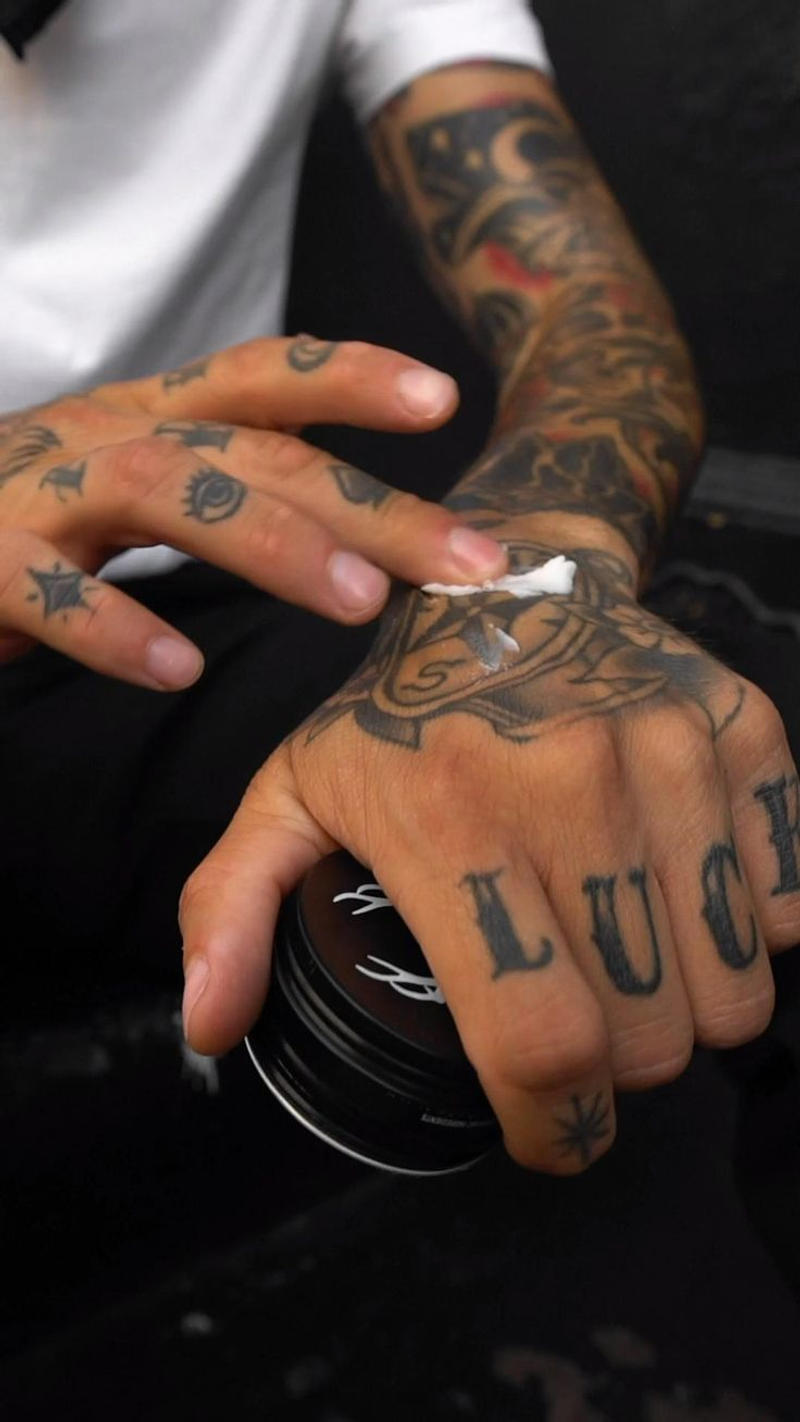
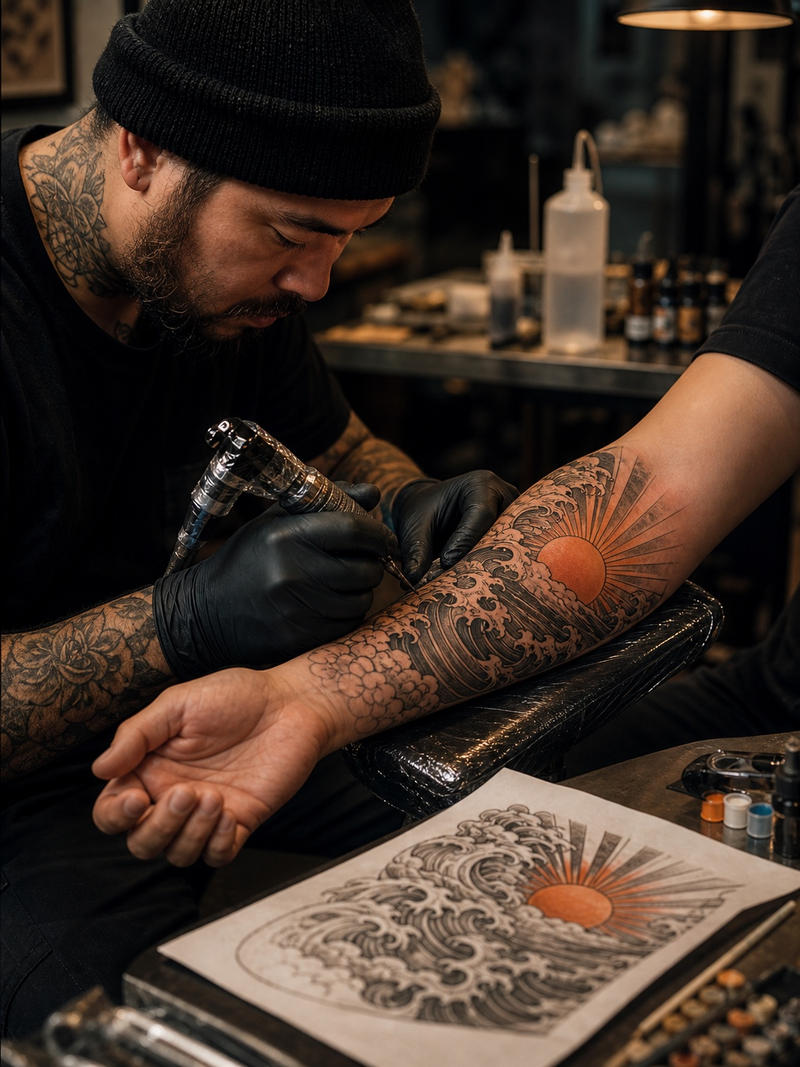
Every year, we run the numbers on which tattoo styles hold up best in our five-year heal data. American Traditional wins. Not by a little.
It's not because it's the "best-looking" style, whatever that would even mean. It's because Sailor Jerry and his descendants engineered a style around a single design constraint: this has to still look right in twenty years, in a bar, in a photograph, on any skin, under any light. Everything downstream of that constraint is why American Traditional keeps beating fine-line, watercolor, and portrait realism in our long-heal scoreboard.
The three rules that define the style
American Traditional is defined by three rules. If any of the three are broken, it isn't really the tradition — it's Neo-Traditional, or new-school, or something worth its own name.
1. Bold outlines
Every element has a thick, black, deliberate outline. Not because it looks good in the moment (although it does), but because a bold line is what remains when everything else fades. Sun exposure, aging skin, weight fluctuation, ink migration — all of it eats at the fine details first. The outline is the promise. Twenty years from now, at minimum, you will still be able to tell what the tattoo is.
2. Limited palette
Reds, greens, yellows, browns, blacks. Sometimes a blue or a purple. That's it. There's a reason. Those specific pigments, dropped densely, are the ones that reliably hold saturation for decades. The exotic palette of a Munich watercolor artist is beautiful — but it fades unevenly, and it fades soon.
3. Iconography from a fixed vocabulary
Roses, panthers, daggers, swallows, ships, hearts, banners, eagles, snakes. A hundred-ish core motifs, plus their well-known variants. Not because tradition is stodgy — because a motif that has already been drawn ten thousand times has been optimized ten thousand times. Every angle, every fill, every negative-space decision has been solved. The traditional rose is beautiful because it's been iterated on for a hundred years.
How to spot a great American Traditional artist
Ninety percent of American Traditional advice is about the artist, not the style. Because the rules are so tight and the reference material is so deep, the difference between a great AT artist and a mediocre one shows up faster than in almost any other style.
Here is what our reviewers, at shops that specialize in the tradition, keep flagging:
— Ink saturation on healed photos. Not on fresh photos. Anyone can make color pop the day of. Look at their 1-year-plus work. Are the reds still red, or are they mauve?
— Line consistency. Every outline should be the same weight, the whole way around the motif. Wobbles and thickenings are a giveaway.
— Negative space discipline. A great traditional piece leaves a lot of skin. It resists the urge to fill everything. If every square millimeter is packed, that's a red flag.
— Composition from a foot away. Ask to see photos taken from a normal conversational distance — not the close-up they post to Instagram. The composition should still read.
Why the tradition keeps winning our data
Our platform tracks a number we call Line Integrity at one, three, and five years. American Traditional artists score, on average, 4.7 out of 5 at the five-year mark. Fine-line scores 3.8. Realism scores 3.4.
This isn't a value judgment. Realism can be stunning in a way traditional can't. Fine-line can be intimate in ways bold outlines refuse. But if what you want is a piece that still reads exactly like the piece you got in twenty years, the tradition already solved that problem for you.
The two-week rule
Here's a small trick from our reviewers. If you're on the fence between an American Traditional artist and someone in a trendier style: mock the piece up (or ask the artist to) and live with the image for two full weeks before committing. Photograph it. Look at it under fluorescent light. Look at it as a thumbnail on your phone.
Traditional pieces will hold up to that test. Trendier styles very often won't.